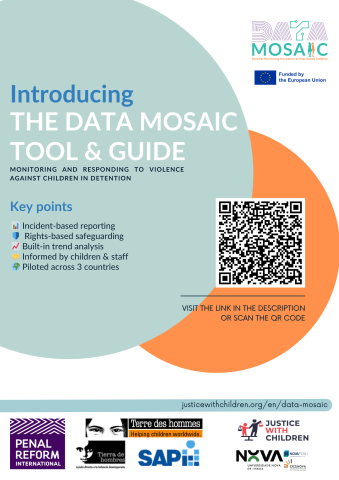
Data MOSAIC Tool and Guide: Strengthen monitoring and response to violence against children in detention
The Data MOSAIC Tool is a practical, rights-based instrument developed to support detention facilities in monitoring, documenting and analysing incidents of violence against children (VAC). Accompanied by a detailed implementation guide, the tool enables timely, incident-based reporting and supports more transparent, accountable, and child-sensitive practices across child justice systems.
Designed as a standalone Excel-based resource, the tool is structured around:
- The clean tool in all languages
- The tools with the test data
- The guides in all project languages
This tool and guide are being released in their piloted edition as Version 1.
The tool draws on research conducted in 25 EU countries, with in-depth studies and national consultations in Bulgaria, Ireland and Romania. Feedback from children, frontline staff, facility managers, and international experts informed its development and piloting. It monitors both interpersonal (staff-to-children and peer-to-peer violence) and institutional forms of violence, while respecting children's privacy and ensuring data is used for constructive, evidence-based responses.
The guide accompanying the tool offers step-by-step instructions for use, data interpretation, and practical response measures, supporting facilities to embed safeguarding into daily practice.
Both tool and the guide has been piloted in Ireland, Bulgaria and Romania.
Key outcomes from its use in Ireland, Bulgaria and Romania include:
- Improved detection of previously unreported incidents
- Increased awareness among young people of their right to report violence or a lack of safety
- Strengthened engagement by staff and facility managers in documenting incidents relating to violence and safety
- Identification of patterns, such as location-specific risks within facilities.
This tool provides a way to build stronger institutional capacity for prevention, protection, and accountability. Future iterations will focus on enhancing usability and integration across diverse detention settings.
This Tool and Guide were developed with funding from the European Union’s CERV-2022-DAPHNE programme. We are grateful to Silvia Randazzo, PHD, for her essential contributions throughout the development of the tool and the preparation of the guide, Joshi Charchit and Sophie Brambley from Linklaters LLP, London, for their valuable support in developing the tool, and all members of the International Advisory Council for their expertise and guidance.
If you are interested in having PRI's support in implementing the Tool, please contact PRI via [email protected].