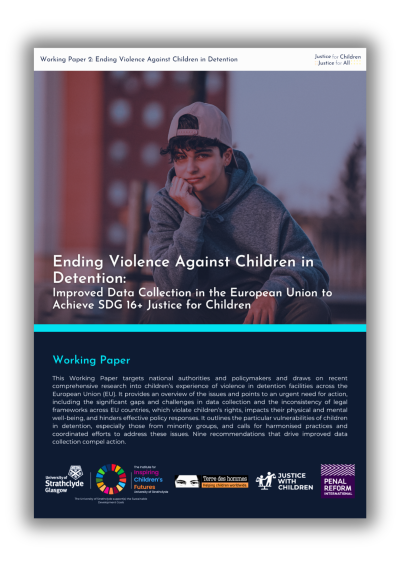
Ending Violence Against Children in Detention: Improved Data Collection in the European Union to Achieve SDG16+ Justice for Children
- Log in to post comments
This Working Paper - Ending Violence Against Children in Detention: Improved Data Collection in the European Union to Achieve SDG16+ Justice for Children -draws on recent research about children’s experiences of violence in European Union detention facilities. It highlights significant challenges related to gaps in data collection and inconsistent legal frameworks across the EU - which violate children’s rights, harm their well-being, and hinder effective policy responses. The Working Paper also features nine key recommendations to improve data collection on violence against children in detention facilities.
Key Messages
- Children deprived of liberty are among the most vulnerable. Children in detention disproportionately experience violence, mistreatment, rights violations, and exploitation. This is particularly true for children from ethnic minority backgrounds and other socially marginalised groups. Together, international standards and targeted national efforts support actions to end violence against children in detention, but also preventing detention in the first place by properly addressing the impact of children’s marginalisation.
- Data collection is inadequate, imprecise and incomplete. The lack of comprehensive data on VAC in detention facilities significantly hampers effective policymaking and resource allocation. This inadequacy affects the well-being of children deprived of liberty and makes it difficult to develop targeted interventions, especially for those facing greatest marginalisation.
- Barriers to reporting continue to be a significant challenge. Children often do not report violence due to fear, distrust and lack of awareness about reporting mechanisms. Children facing the greatest marginalisation - such as girls, LGBTQI+ children, children with disabilities, and neurodivergent children - face higher risks and are often overlooked in data collection practices. Specific prevention measures and responses are essential.
- Implementing effective data strategies is a critical driver of much needed progress. Pilots and demonstration projects from EU member states can become promising practice examples that are replicable in different local and national settings. Examples include monitoring bodies and processes, the Data MOSIAC Tool, strong, efficient legislative frameworks, and child-centred justice system reforms.